| Home | About | News | Contact us |
|
The following
is excerpted from "Sea of Slaughter" (1984) by Farley Mowat, |
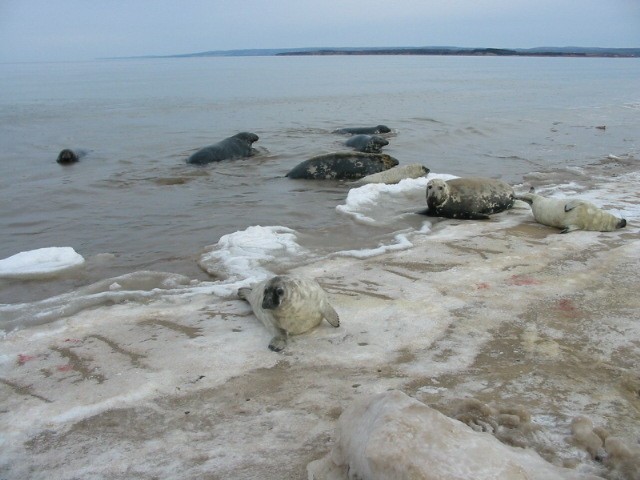
| Dotars and Horseheads continued... In support of what amounts to a writ of execution, three specific charges are laid against the horsehead bby Fisheries and Oceans. First: they are extremely destructive of the gear and catches of inshore fisherman. Second: they eat tremendous quantities of fishes that would otherwise be harvested by commercial fisherman. Third: they spread a parasite known as the cod-worm, which reduces the retail value of cod fillets and imposes a heavy burden on the fishing industry. Not only are all these charges specious in the extreme, they are for the most part patently untrue. Let us examine them one by one. Fishing is and always has been a risk enterprise. Fisherman expect to lose gear and calculate accordingly. However, the actual damage done to catches and gear by all species of seals in Canadian Atlantic waters amounts to less than 1 per cent of losses sustained from storms, passing ships, malicious damage, sharks, even jellyfish that clog nets so that they are swept away by powerful tidal streams. On the basis of data that are themselves suspect, the department asserts that horseheads consume 50,000 metric tonnes (1980 figures) of valuable fishes every year, or 10 per cent of the half-a-million tonnes taken by Canadian east-coast fisherman. Analysis of this charge demonstrates that less than 20,000 tonnes of the consumption attributed to horseheads (but by no means proven) is of species of even marginal commercial value. Furthermore, the presumed tonnage represents live weight-the weight of the whole fish-while the figure for the commercial catch is based on processed weight-only that portion of the fish that is packaged for sale. The live weight taken by Canadian commercial fisherman in 1980 was approximately 1.2 million tonnes. The percentage of commercially valuable fish eaton by the seals can therfore be no more than 1.6 per cent. Statistics are sometimes designed to lie, and that these figures from Fisheries and Oceans were so designed is established by a statement that Dr. Arthur Mansfield and Brian Beck, senior marine biologists with the department, published in the Technical Report of the Fisheries Research Board of Canada. "The [available] data suggests that the two largest commercial fisheries, those for herring and cod, suffer little competition from the grey seal." The final charge has to do with the fact that the life of the thread-like cod-worm is lived partly in the digestive tracts of seals (and some other animals) and partly in the muscular tissue of cod. The worm itself does not present a health problem to man. It does pose a cosmetic problem, but one with which fish-plant owners have long known how to deal. Operators inspect the cod fillets using a process similar to candling eggs and remove the worms. Just how heavy an economic burden this imposes on the $2-billion Canadian fishing industry can be judged from the fact that, in 1978, the thirty major east-coast plants employed a grand total of sixty-five people, mostly women and mostly part-time, to deal with the cod-worm problem. I might add that these sixty-five jobs were, and remain, desperately needed in the chronically underemployed eastern provinces of Canada. Nor is this all. The prestigious Marine Mammal Committee of the International Council for the Exploration of the Sea, meeting in Denmark in 1979, considered all the available evidence on the cod-worm problem and concluded: "We are unable to say whether a reduction in the [cod-worm] infection of cod would result from a reduction in seal numbers." Fisheries and Oceans directs much the same set of charges against the harp, hood, and dotar seals. However, the latter can no longer pose any conceivable threat to the well-being of the Canadian economy. Between 1926 and 1954, the dotar population was reduced by the bounty hunt from an estimated 200,000 to less than 30,000. Not content with even the massive destruction, Fisheries doubled the bounty, with the result that, by 1976, according to government biologists, fewer than 12,700 dotars still survived in eastern Canadian waters. Most of these held to their precarious existence on lonely stretches of coast uninhabited by men who either fished-or voted. In 1976, after a half century of "management," the federal authorities decided that the destruction of the species, had been effectively achieved and that the bounty no longer served any physical or political purpose since hardly anyone was bothering to hunt the few remaining and now very wary dotars. However, by the stunning coincidence, they simultaneously concluded that the "controlled cull" of horseheads was not depleting that species fast enough; so instead of being cancelled, the bounty was switched from one species to the other. The switch provided no chance of recuperation for the dotars since most bounty-paying officials could not tell the difference between the jawbone of a young horsehead and an adult dotar. Futhermore, the new bounty had been enriched to $25. such largesse brought the unters back in droves to take part in a revived and general slaughter of both species. The jaws of 584 horseheads and an unreported number of dotars were turned in for bounty during 1976; but this figure represents as little as a fifth of the actual kill. As the mandarins of Fisheries and Oceans are fully aware, one of the advantages of employing the bounty system against seals is that, for every one shot and recovered, several more sink to the bottom dead or later die of wounds. In July, 1976, department employees interviewed eighteen fisherman who reported that of 111 seals shot at and presumed wounded or killed, only 13 per cent were recovered. These deaths do not, of course, appear in the official statistics; but it is obvious that the bounty paid in 1976 represented the destruction of at least 1,500 and perhaps as many as 2,000 horseheads. Although the bounty-engendered kill increased in each of the years 1977 and 1978, this ws not enough to satisfy the Minister of Fisheries and Oceans. In 1979 the bounty was doubled, to $50 for each adult seal. To wet the appetites of hunters even more, an additional $10 was paid if the seal had been branded and a further $50 if the corpse bor a tag. In that year, more than 3,000 horseheads were slaughtered in what had become a perverse lottery of death. If
the hunters were to be selected as expert and responsible marksmen, the carnage
might not be so quite appalling, but they are not. Although the department piously
insists that only "bonafide fisherman who have suffered In 1979, I tried to persuade Fisheries and Oceans to withdraw the bounty, citing some of the abuses connected with it. It was told the matter was under review. The following year I submitted a detailed report of demonstrable biocide against the seals to the man responsible for it-the Honourable Romeo LeBlanc, Minister of Fisheries and Oceans. Four months later, he replied to the effect that he and his scientific advisers were satisfied there was no cause for concern. He concluded his letter with this remarakable statement: "Our policy is to build the stocks of a harvestable fish and marine mammals to levels which will permit regular but controlled catches by Canadians while ensuring the well-being of these valuable resources. It has never been the Department's intent to do otherwise." The cumulative destruction resulting from the payment of blood money to hunters, began in1976, together with the "cull" at the rookeries, has now resulted in the deaths of at least 50,000 horseheads (and some thounds of dotars). It is somewhat difficult to comprehend how the "well-being" of these particular "valuable resources" is being ensured. At the annual meeting of the International Convention on Trade in Endangered Species held in Europe in the spring of 1981, the spokesman for France pointed out that both grey anf harbour seals were in trouble, world-over. He proposed that they both be listed in Appendix II of the Convention, which is designed "to avoid ulitization incompatible with the survival of a species." Canada refused to support the resolution. This was a least consistent. Canada has long since refused to join the United States, which extended full protection to both dotars and horseheads as early as 1972. Now LeBlanc chose to implement the 1981 recommendations of the Canadian Atlantic Fisheries Scientific Advisory Committee. This ponderously named grooup has its chief through uundeclared raison d'etre the furthering of government policies. Its proposal was: "As a short term strategy, aimed at either stabilizing of further reducing the grey seal population, between 8,000 and 10,000 animals [should] be killed for [each of] the next two years." Fisheries and Oceans made every effort to carry out this recommendation. Yet, although 1,846 horseheads were "culled" at the rookeries in 1892, and the record number of 2,690 (1,627 pups and 927 adult females) in 1983, the target remained elusive. The truth was there were not that many grey seals in existence in mainland coastal waters. Had the "cull" been extended to Sable, that last refuge of the horeseheads, the committee's goal might more nearly have been achieved. Ther is no doubt that it was the intention of Mr. LeBlanc's department to visit the Conservation and Protection death squads on Sable's rookeries. But, considering the problems Fisheries and Oceans was then having in defending the "cull" of harp and hood seals in the face of mounting international protest ( a matter dealt with in the following chapters), discretion as to the slaughter of seals on Sable was accounted the better part of valour-for moment anyway. |
 financial
loss from seals" are permitted to shoot them, the truth is that any
resident of the Maritime Provinces old enough to carry a gun can be a bounty hunter.
Any Nova Scotian, for example, need only buy a non--commercial fishing permit,
for $5, in order to validate an additional $1 permit to carry and use a rifle
for seal hunting throughout the year. Hundreds do this, hunting for pleasure as
well as profit. They shoot every seal they find, or whatever species, for
the sport of it-and on the chance that it may be a horsehead. Since they are empowered
to use rifles even during the closed season for other game, they take advantage
of the opportunity to practise their skills on dolphins, whales, eider-ducks,
and even-I have seen this myself-on tuna.
financial
loss from seals" are permitted to shoot them, the truth is that any
resident of the Maritime Provinces old enough to carry a gun can be a bounty hunter.
Any Nova Scotian, for example, need only buy a non--commercial fishing permit,
for $5, in order to validate an additional $1 permit to carry and use a rifle
for seal hunting throughout the year. Hundreds do this, hunting for pleasure as
well as profit. They shoot every seal they find, or whatever species, for
the sport of it-and on the chance that it may be a horsehead. Since they are empowered
to use rifles even during the closed season for other game, they take advantage
of the opportunity to practise their skills on dolphins, whales, eider-ducks,
and even-I have seen this myself-on tuna.