| Home | About | News | Contact us |
|
The following
is excerpted from "Sea of Slaughter" (1984) by Farley Mowat, |
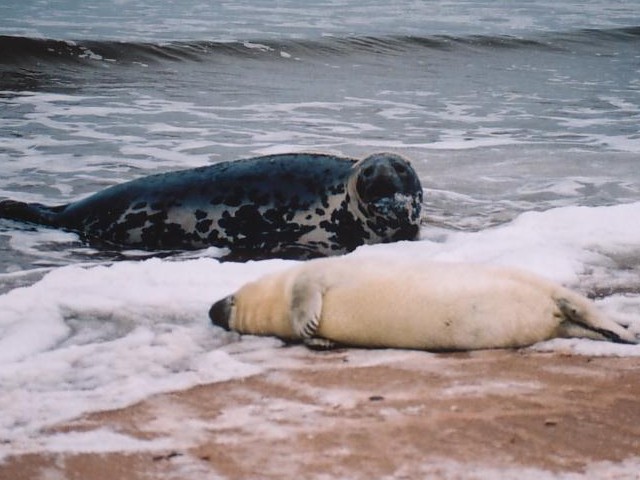
| Dotars and Horseheads In 1949, Dean Fisher, a young Fisheries researcher, made a discovery of the kind every field biologist dreams about. Employed by the federal government of Canada to study salmon in New Brunswick's Miramichi River, Fisher was investigating relationships between salmon and harbour seals. Choosing a hot August day of the sort that tempts seals ashore to lounge on the sandbars of the river mouth, Fisher proceeded to make a count of the recumbent animals through his binoculars. Almost at once he noticed occasional seals of enormous size - far larger than harbour seals had any right to be. Puzzled, he worked his way closer, focused on one of the monsters, and realized with near incredulity that he was looking at an animal that had been unreported for so long that some biologists believed it to be extinct in North America. The creature Fisher officially rediscovered that summer day is known to science as the grey seal. Early French arrivals in the New World called it loup marin, not because of any presumed wolfish nature but because of its haunting cries, which sound eerily like the distant baying of wolves. Since it was visibly the most abundant seal, this name soon came to be used in a generic sense, applied to all seal species. Thereafter both French and English called the present species by the distinctive name of horsehead because of the characteristic equine profile of the males. It is still best known by this name, which is the one I shall generally use. Of the several kinds of seals frequenting the northwestern approaches when the European invasion began, four were pre-eminent: hood, harp, harbour, and horsehead by name. Although hoods and harps were the most numerous, they were of small importance to the human newcomers, being present only during winter and early spring and even then mostly staying so far offshore as to be seldom seen. Horseheads and harbour seals, on the other hand, lived year-round in astonishing profusion almost everywhere along the northeastern coasts of the continent. The horsehead is by far the larger of these two; an old male may be as much as eight feet in length and weigh 800 pounds. Although females average only about seven feet, they still seem enormous compared to the harbour seal, in which species neither sex exceeds five feet or weighs more than an average human being. Gregarious and polygamous, horseheads used to gather in January and February in enormous numbers on myriad island and even mainland beaches from Labrador to Cape Hatteras, there to whelp and breed. Some of the colonies were so large that, as late as the mid-1600s, the lupine howling from them could be heard several miles away. They tended to keep together during the balance of the year as well, forming large, convivial companies of up to several hundred individuals fishing together in inshore waters and hauling out to sun themselves in somnolent mobs on bars in salt-water lagoons and at river mouths. This was a preference they shared with their gigantic relative, the walrus. They even shared the same whelping grounds, although at different seasons. Harbour seals, called common seals in Europe or dotars in Newfoundland (the name I prefer), now survive mostly in small family groups. Originally they seem to have been more sociable and their colonies were scattered in bays, estuaries, and inlets from the Carolinas north into Arcitc regions. They also made themselves at home in fresh water. Prior to 1800 a colony actually lived in Lake Ontario, wintering below the great cataracts of the upper St. Lawrence River. What was probably the last member of this now-vanished band was killed at Cape Vincent on the south shore of the lake in 1824. Dotars undoubtedly inhabited many of the larger rivers draining into the Atlantic, too; but the European invaders soon hunted them out of these. Their current predilection for wide dispersal and their secretive and isolated breeding habits seem to be relatively recent adaptations, forced on them by the predation of modern man. Jacques Cartier's anonymous scribe provides the earliest direct reference to the horsehead. While Cartier's second expedition was coasting the northwest corner of the Gulf of St. Lawrence in 1535, some of this men rowed into the sandy estuary of what is now the Moisie River to investigate a certain "fish, in appearance like unto horses...we saw a great number of these fishes in this river," which Cartier named Riviere de Chevaulx. Further west, at the mouth of the Pentecost River, the expedition found "Large numbers of sea horses" and we are told that more were seen all the way west to the Indian village at the present site of Quebec City. Cartier's scribe also noted the presence of another and smaller seal, which was evidently the dotar; but it was the sea horse that most interested the St. Malo entrepreneur. He would have been quick to realize that the oil from such huge, blubber-encased creatures offered a rich opportunity for profit. As we have seen, one of the most valuable products from the northeastern portion of ;the New World during the early centuries of European exploitation was train oil. Some of those seeking it concentrated their efforts on whaling, and some on walrus hunting - enterprises that required considerable skill and large investments. Seal hunting required neither. Seals could be killed by the merest tyro, yet their oil could make a modest fortune for anyone who could scratch together a ship, a crew, and a trypot. Furthermore, seal hides were also of considerable worth. The little dotar was a first ignored because of its small size and relatively low yield. Even as late as 1630, Nicolas Denys noted "There is scarce anybody but the Indians who make war on them." Their time would come. Meanwhile, the horsehead was the seal nonpareil. When Sir Humphrey Gilbert was touting his colonizing venture in 1580, he issued a brochure listing horsefishes among the prime exploitable resources in the new lands. A brief account of the voyage of the English ship Marigold, in 1593, makes a point of remarking that the expedition found "great store of seals," particularly on the west coast of Cape Breton Island where a remnant population of horseheads still remains. The port books of Southampton tell us that, by 1610, an annual seal fishery was being conducted in Newfoundland during the summer season, when no other species except horseheads and dotars would have been available. A few years earlier, while exploring southern Nova Scotia and the Fundy and Maine coasts, Samuel de Champlain noted numerous island "completely covered with seals" and heard of others where Indians killed seal pups in wintertime. Both references must have been to horseheads. One of the earliest commercial ventures of New England colonists was sealing, and they pursued it with the efficacy that was to make their descendants legendary. They took to raiding the long string of horsehead breeding islands off thier coasts during the pupping season, slaughtering all the young and as many adults as they could get. So ruthless were they that they soon eliminated the horsehead as a profitable commodity on their own coasts. They then sailed north, and by mid-seventeenth century Nicolas Denys was complaining bitterly of thier incursions into his Magdalen Island fiefdom where horseheads were to be found in the great lagoons in tens of thousands. Denys intimated that he had devised a new and more effective way to fish them there; but, being a properly cautious merchant, he refrained from committing the details to print. The French, who were the first permanent European residents of southern Nova Scotia, were as voracious as the New Englanders, as Denys makes clear in his account of the horsehead fishery. "[The seals] come for their lying-in about the month of February...and take position on the island, where they give birth...Monsieur d'Aunay sends men from Port Royal with longboats to make a fishery of them. The men surround the islands, armed with strong clubs; the fathers and mother flee into the sea and the young, which are trying to follow, are stopped, being given a blow with the club on the nose of which they die...Few young ones save themselves...There are days on which there have been killed as many as six, seven and eight hundred...Three or four young ones are required to make a barrel of oil, which is as good to eat when fresh, and as good for burning as olive oil." The Sieur de Diereville witnessed a similar slaughter in Acadia at the end of the seventeenth century and was moved to pen a poem about it. Apart from the archaic language, it might have been written by a seal-hunt observer of today. It ends: The
Hunters, armed with heavy clubs, |